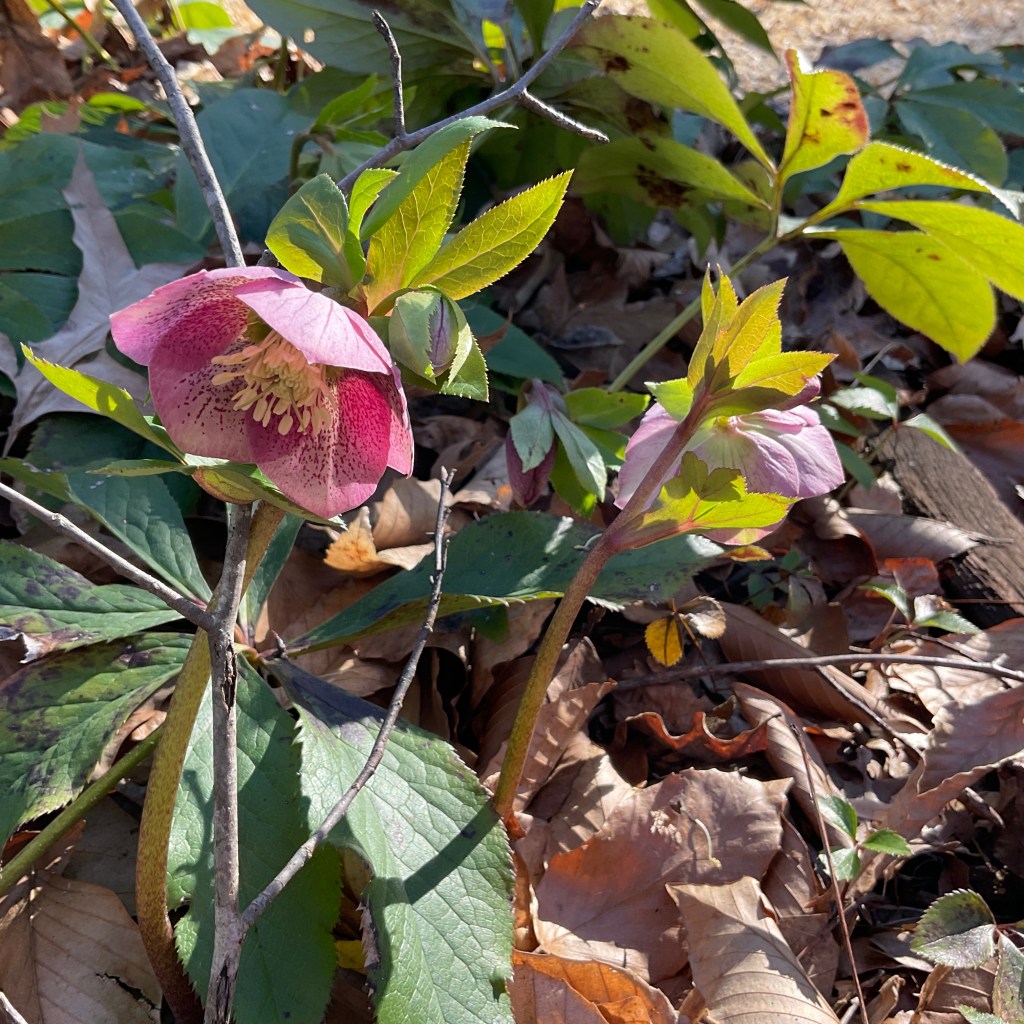
It’s winter here in the Southern Piedmont though the 65 degrees today deny it; the landscape is still grey, brown and tan. Experience, and the calendar, give me hope though—spring is coming! The first harbinger is our Lenten roses. They are blooming true to their name since Lent begins tomorrow. Though easily overlooked since they hang their pink or white (even almost red) heads down, Hellebores are beautiful.
They multiply readily with lots of large palmate leaves that stay evergreen—a bonus unless you want them to share space. They love shade that most other plants can’t tolerate, so that probably won’t be a problem. Lenten roses take practically no care so they’re easy to live with.
I was on a mission. I looked out my window and spotted some white flowers at the edge of my vegetable garden. Wow! What are those? Ah, the mini gardenias my landlady said I could cut for indoors. I donned my knee boots (quicker than lacing up shoes) and trod out purposefully, scissors in hand. Suddenly I stopped, rubber-booted foot in mid-air; right in the path was this beautiful creature—a turtle. I’m so glad I didn’t step on it! I was fascinated by its golden symmetrical–and asymmetrical, markings that extend to its head. They’re almost like ancient writing.
At first, it’s pointed mouth led me to believe it might be a snapper so I kept my distance, but an internet search told me that it is instead, an Eastern Box Turtle, unique in being able to completely close off its shell. A friend tells me that they can nevertheless bite. It’s the State Reptile of North Carolina. I had no idea there was such a thing; I’m relieved that they didn’t choose a snake!
I also discovered that these turtles eat slugs and bugs, and other things that aren’t welcome in the garden. However, the turtles apparently extract their pay for such a service by eating fruits, and roots. We’re not real happy about that part since bunnies–even a tiny one, have been eating our plants (my neighbor and I garden side-by-side) down to the nubs. I know God’s creatures have to eat but we live in a wood, so there’s plenty there for them.
Not to worry though, the turtle came, saw, and slowly wandered back into the woods. It hadn’t been previously seen, and I haven’t seen it since. I count it a privilege that I was there at just the right time to have seen it.
Have you had experience with Eastern Box Turtles—a close encounter, or as a friend?
(I say a “friend”–one who visits, rather than a pet since in North Carolina it’s “unlawful to hunt or trap them…or to take from the wild, have in their possession” https://www.ncwildlife.org/species/eastern-box-turtle)
A woodpecker hunts for his lunch in a dead tree in the surrounding woods. The sky is blue again with a few white clouds cooling the warmer weather.
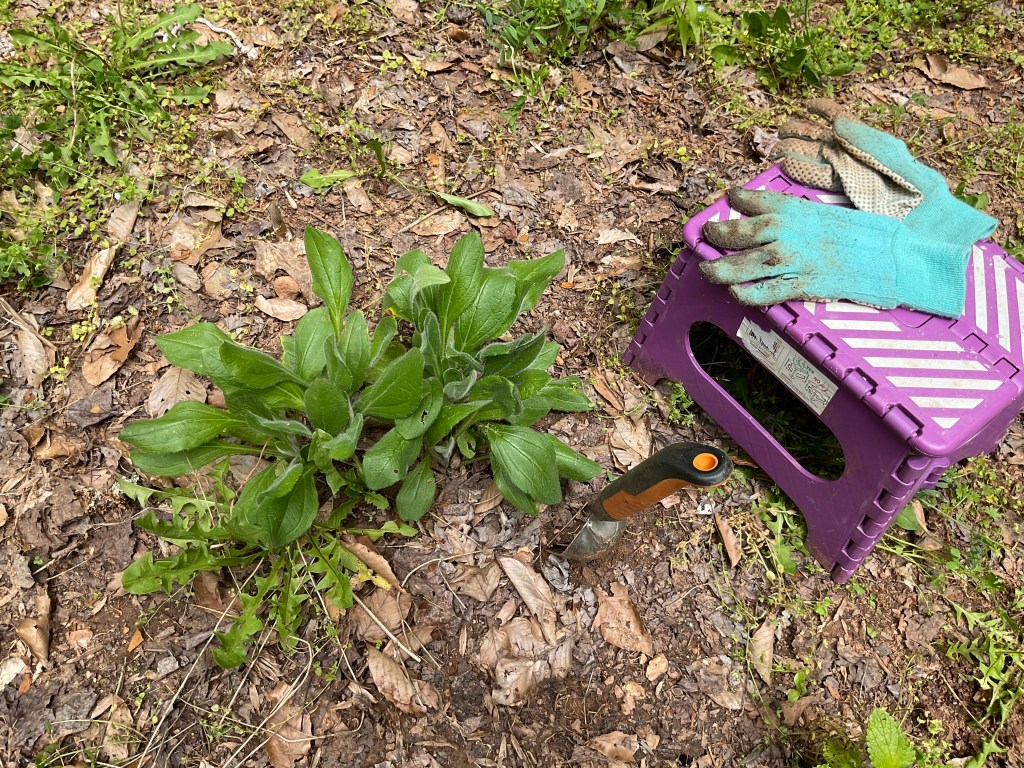
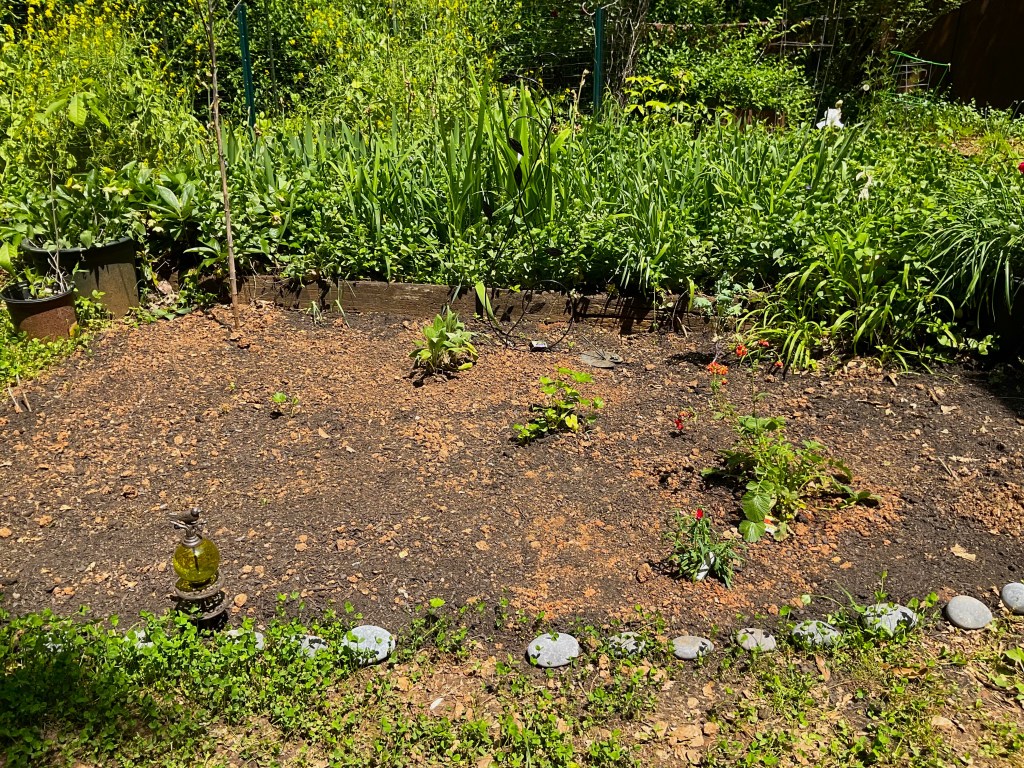
Today, I started my gardening with digging up my rudbeckia/black-eyed Susan from my still weedy vegetable plot. I’d bought it in a pot as a fundraiser at the previous place we lived; though I had no garden there, I looked forward to our next home, which would surely have a garden. Actually it was a non-negotiable for me to have a garden in our next home. Gardening is necessary for my well-being. (The NHS of the UK (National Health Service)increasingly prescribes gardening for good mental health.)
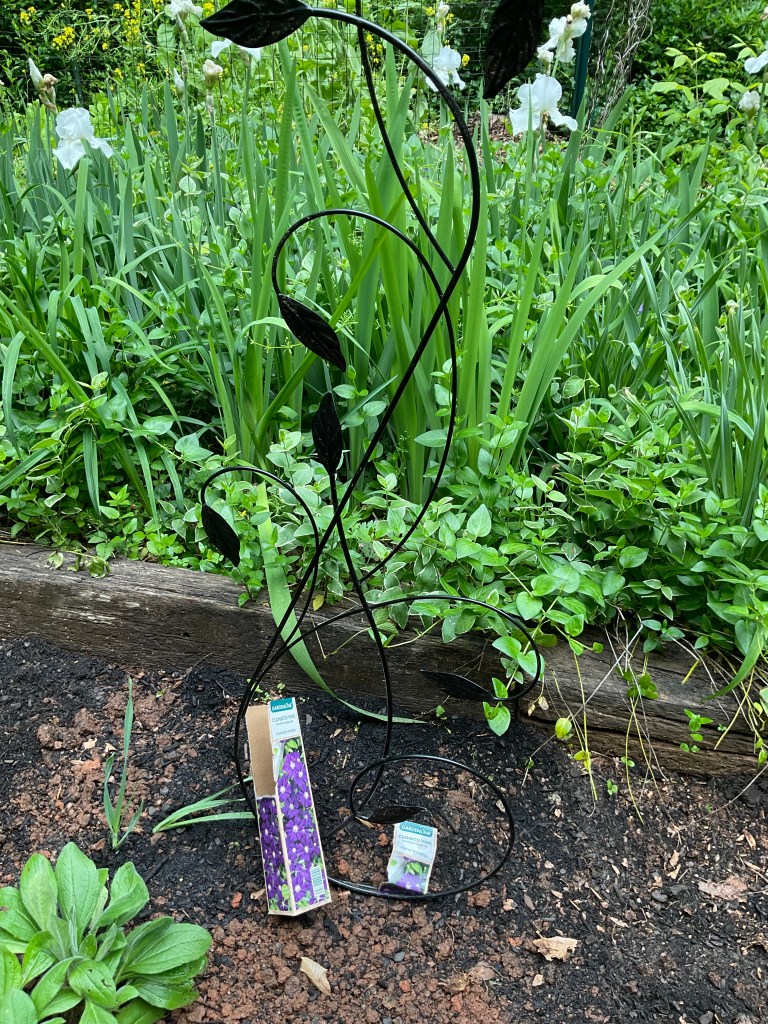
As a young girl, I loved to answer ads for garden catalogs in the back of my mother’s magazines. I’d tape my precious dime to an index card, slide it into a small white envelope, address it to the seed company then ask my mother for a stamp. A clothes pin held my request to an arm of our mailbox for the postman to pick up (yes, our postal worker was a man). I’d eagerly check the mailbox several times every day until the wondrous day my picture book, aka seed catalog, of colorful flowers finally arrived. As I pored over the pages of “dahlias the size of a dinner plate!” and other “exotic” flowers, one plant stood out. I’d never seen a clematis growing in hot, humid Texas but the purple-flowered vine captivated me. Recently, our landlady presented me with a gift of a purple-flowered clematis—my first. I hope I grow it well in the Southern Piedmont. I found a lyrical trellis of black wire and metal leaves, to support it when it does grow.
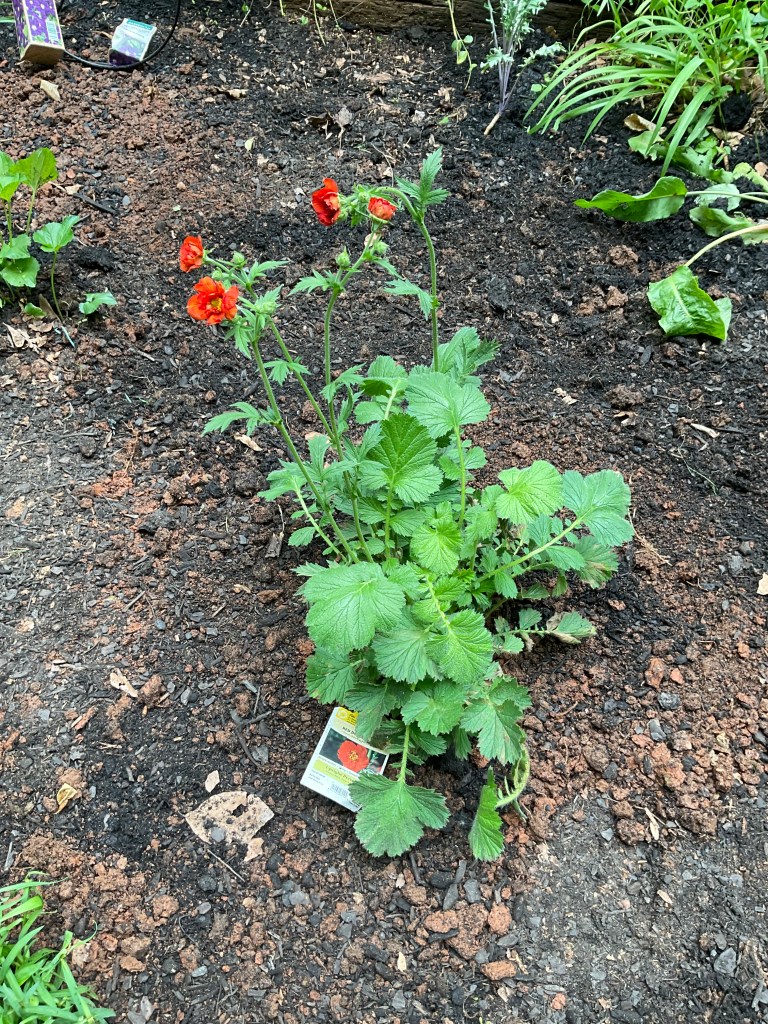
The other night, the BBC Gardener’s World TV show (I highly recommend it) had a feature on geums, reminding me of how much I enjoyed the orange-flowered perennial I grew in my garden in England (see older posts for the story of that garden). I came across a geum plant at the local big box garden center and of course, I needed to buy one. I have some flower seeds to plant but it’s good to have some already flowering plants to get the garden started.
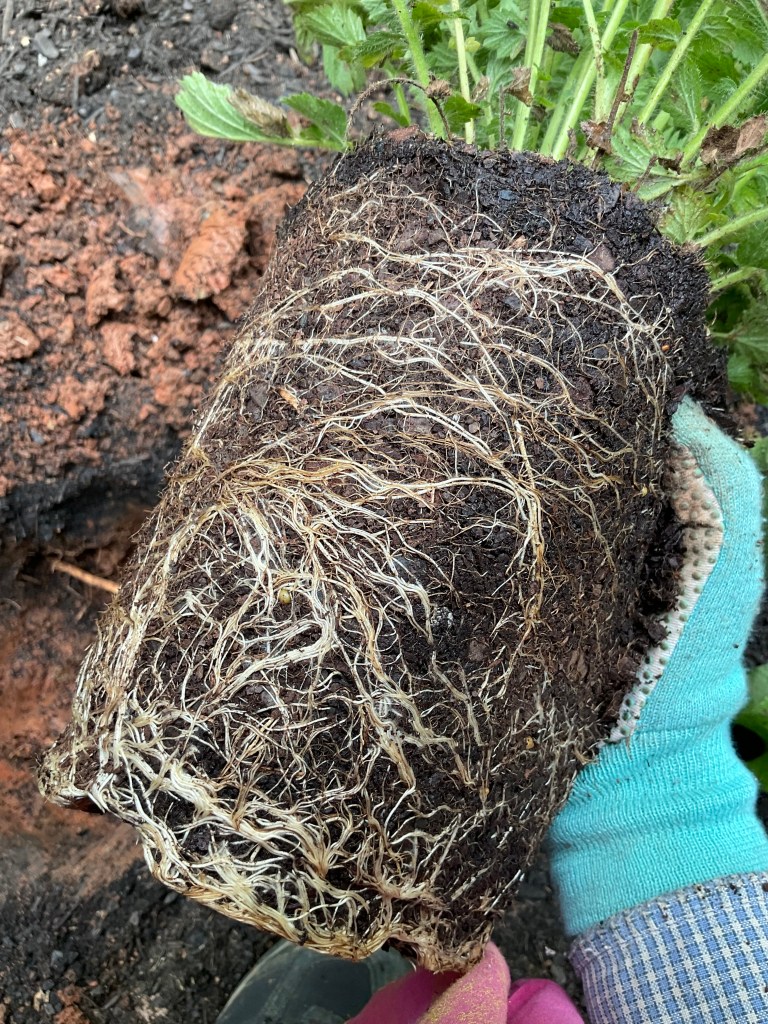
I also learned on Gardener’s World that when sliding a plant out of its pot for transplanting, it’s good to run a finger over the bare roots to stimulate growth. This plant was definitely ready to be free of its pot and be planted in the ground.
Transplants have to be well watered. I’ve had to water the transplants more than I expected, even when it had rained; it takes a few days for them to get established.
Progress! There’s still a lot to be done, which is a good thing, but I have to remember that the zinnias, and tithonias I have planned, take up a lot of space.
Do you prefer to grow your flowers from plants or seeds? Or both? I’d love to hear from you in the comments below. Please feel free to share these posts with your gardening—and garden-loving, friends.
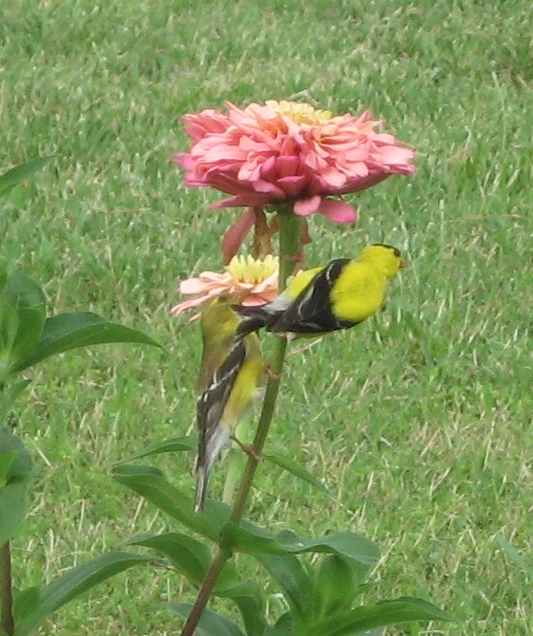
Everywhere we’ve lived for the last couple of decades, I’ve asked God to send some golden yellow, black-winged American goldfinches because they’re some of my favorite birds. Why? I love their audacious color! And he has. Goldfinches have bobbed on tall grasses behind my apartment balcony, dined on my fading zinnias in my wide-open former pasture honest to goodness in the dirt garden—no need for deadheading, they did it for me. When I told an older woman who loves birds, that I pray for goldfinches and Father sends them, she fussed at me, exclaiming, “If you’re going to pray them in, you’d better feed them!” Hmm, being somewhat nomadic, I couldn’t get a feeding program started since I couldn’t keep it going. What could I do? God would have to feed them. He did; the seeds of the zinnias and towering sunflowers I grew at the time suited the goldfinches just fine.
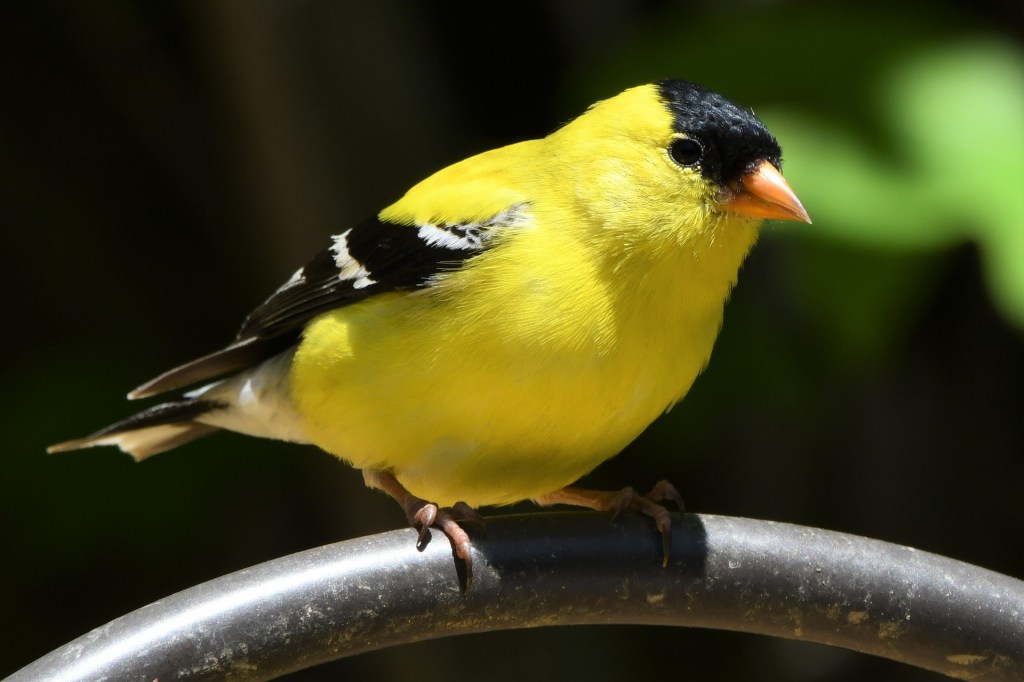
One of the American goldfinches God sent to my garden
I asked my heavenly Father to send them to my gardens, and he has—for my joy, simply because he loves me. But when we lived in England, I didn’t ask because American goldfinches don’t live there. My heart sank when I realized that I wouldn’t see them there; certainly, England’s goldfinches are beautiful and colorful, but not the cheeky yellow-colored ones that I love.
Now that I’m back in the US and have planted a garden here again, I’ve asked God again to send me a goldfinch—this time I added, “in a way that I can see it.” A couple of days later, as I looked out our window onto our porch, I saw a large streak of yellow zip by in that downward arcing way that low-flying birds fly. That’s how I knew it was a bird and not a butterfly. Was it a goldfinch? On my porch? My eyes couldn’t be sure, but my spirit leapt.
A few days later as I rested among my pots of plants, I talked to Father about it again. “I think you sent me a goldfinch, as I asked, but it flew by so fast, I couldn’t see it. Would you send me one where I can get a good look at it?” The same day, as I sat in my art studio looking out the window grieving the news of the death of a family member, something flitted in the window box outside the window. Probably a hummingbird since our neighbor feeds them, I thought. I leaned in to see it better. But it wasn’t a hummingbird, it was a goldfinch! It lingered for a couple of minutes eating from my Victoria Blue salvia stalks in clear view!
The next day, I asked God to keep the goldfinch around my garden all season, then I clearly saw it flying off my porch that day, to a nearby large tree. It had stayed.
God had heard me and given me what I’d asked. As Hagar in the wilderness proclaimed, “You are the God who sees me” (Genesis 16:13). Sending a particular bird in a particular way just for my joy seems a little thing but God does care about every little thing since he created all the heavens and the earth and every little thing in them. He cares about you.
What has little thing has God shown you to let you know he’s listening to you?

 A Leafy Journal