Water of Life

IMG_3537

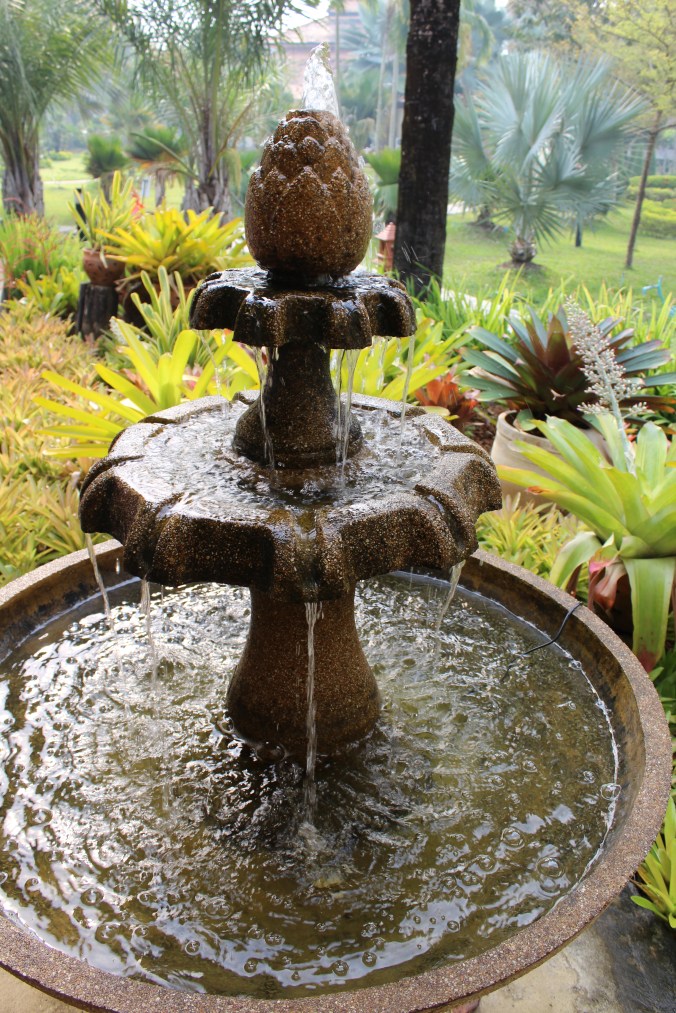
Fountain in Thailand

Water features have again become an important aspect of gardens; whether a lily pond, fountain or stream; water refreshes, soothes and fascinates.  Europe boasts many grand fountains in city squares, whilst smaller ones grace gardens in various parts of the world—walled or open, like this lovely one I found in Thailand.  Peoples of parched middle eastern lands seem to especially love the contrast of water with the dry earth.

Water is refreshing.

But it doesn’t have to be a massive installation to be lovely.  Years ago, in the US, I bought a pond kit with a large plastic bowl, a miniature water lily—it really bloomed, and a mini cattail, for $10.  That was one of the best “$10” I ever spent.  I received so much pleasure from watching the reflections on the water, the plants, and the variety of wildlife that made its way to our balcony.
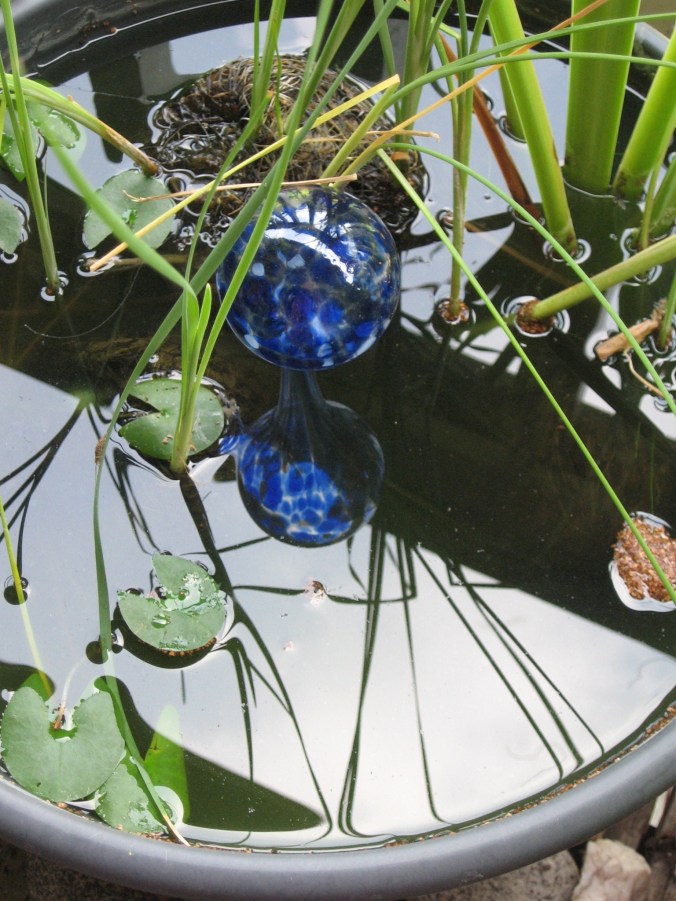
Lily Pond with reflection

$10.00 Lily Pond and glass globe

But I thought fountains were another thing altogether, costing a lot and requiring complicated installation. When I saw in a garden magazine last spring, that I could get a solar powered fountain to float in a bowl– for a few quid, I was in!  Though the description said it would only run when the sun was shining, I’ve found that it runs on what it gained from the sun until it runs out.

I placed it where we can see it from the kitchen window and enjoy it when we eat outside. The sparkles of light reflecting off the drops of water make me happy; the gurgling sound of the pump soothes.
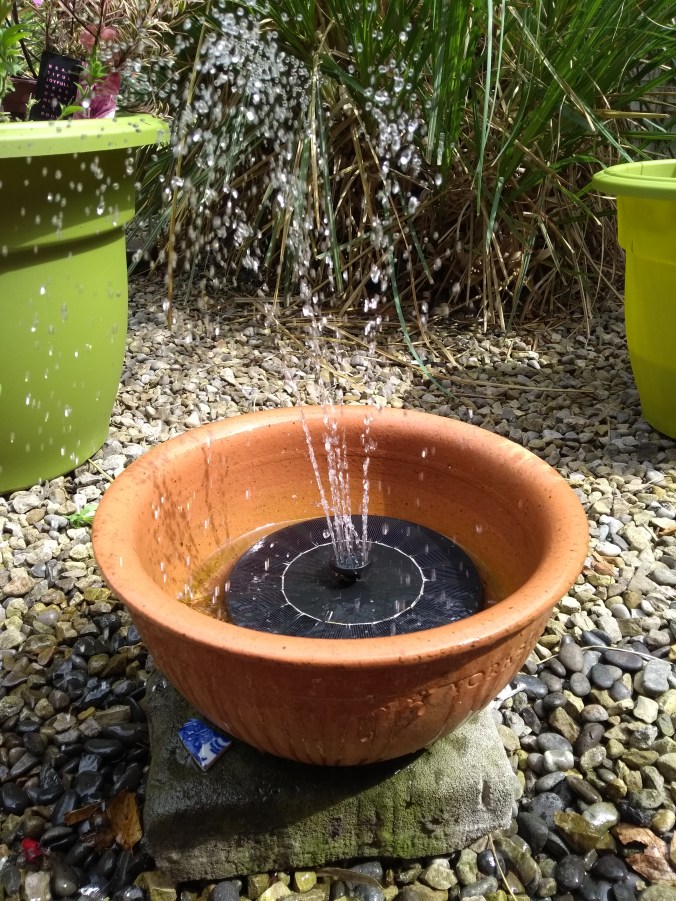
Solar foundtain

My inexpensive solar fountain

Moving water is refreshing, especially when it’s the River of the Water Life that runs through the middle of a golden street in the New Jerusalem, the city Jesus has built in heaven and will bring down to the earth when everything from the old way of life on earth is done.  As a visual artist, I’m exploring what the city will look like and blogging about my process of making a series of canvases about it. My latest post is about this living water.  Have a look, here: http://www.joancthomsonart.com/blog/2019/9/19/river-of-the-water-of-life-part-2the-river
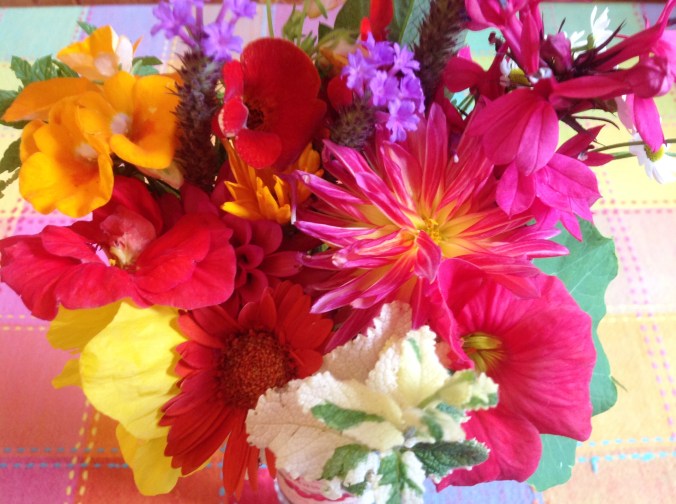
Colour on a Stem

Garden Flowers

Several people have lately told me, “I only plant the kind that come back every year.”  That’s good; it saves time—and eventually, money.  I plant perennials too but as a renting “foreigner,” I don’t want to invest too much since perennials tend to cost a lot more.  That aside, how can I refuse the glorious fiesta colours-reds, oranges, yellows, pinks—even purples, of zinnias (though mine grow as slow as treacle pours) or the cheerful trailing nasturtium of Monet’s Giverny? Do without fragrant, velvety petunias? I can’t. Surprisingly, petunias make okay cut flowers. Or what about stately golden sunflowers (though the snails do seem to love them)? No, the garden would be poorer without these dazzling, often bigger blooms.

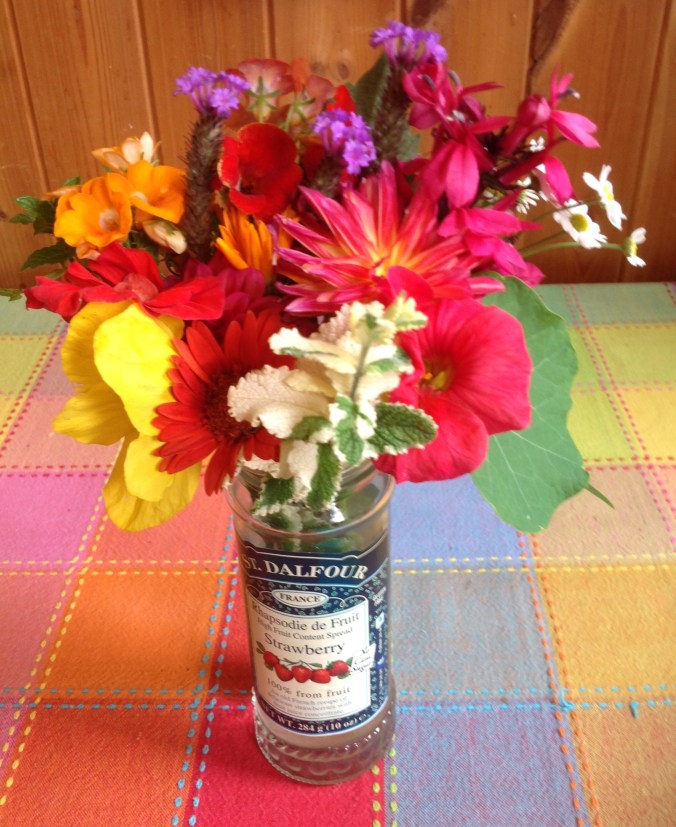
I love cutting flowers from my garden and bringing them in our home–annuals and perennials.  My “vases” are an odd assortment of jars, bottles and cups plus a few small “real” vases.  For some reason, I never find a vase that I like in the shops—that I can afford, so these bits and bobs are fine. I cut the flowers first, then fit the vase to them.  The best time to cut flowers is in the morning when they retain the most water. Cut flowers should be displayed away from sunny windows and any heat source including TVs and radiators. Ideally, the water should be changed daily and the stems re-cut at an angle.

Cut Garden Flowers

Though I spent about five years working in the floral industry—not as glamorous as people think but better than working at an office desk in my view, I tend to keep my arrangements simple.  I keep remembering that my grandmother preferred a natural look in her flower arrangements, “like they grow in a garden.”


Happy Wilma

This is “Wilma,” the canna—“Happy Wilma,” so named by her developers.  Born in a

canna

Happy Wilma Canna

subtropical climate, I’ve always enjoyed the flamboyant and colourful plants.  I had planned to find one with yellow and green striped leaves and orange flowers—and I did, but Wilma had more flowers, cost less and was easier to carry home on the bus.  Besides, her colours were beautiful too with reddened leaves and bursts of yellow orange and coral flowers, so she came to home with me to be the back anchor of our long garden.  There’s no missing her even from a distance.

After the first flush of blossoms, for a while, only the leaves showed their colour, so I prayed over the plant. Then Wilma was happy again—really happy, with two spires of blooms!

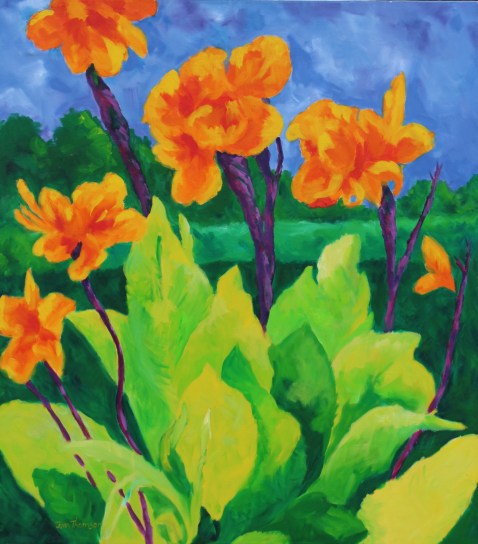
When I studied art in college, I painted a large yellow green- leaved canna and called it Flambeau. Later, I painted it again as part of a large church mural. Initially, a friend told me that she really didn’t like that part of the mural

oil painting orange cannas

Flambeau

because it reminded her of a destructive fire in her childhood home. Week after week as she looked at it; Jesus healed her memory of the traumatic event.  She didn’t know that the painting was named Flambeau—Burning Torch. God uses plants and paintings to heal.


Transformations–A Path

There’s nothing like transformation—book and movie plots rely on it; if a character

IMG-4743

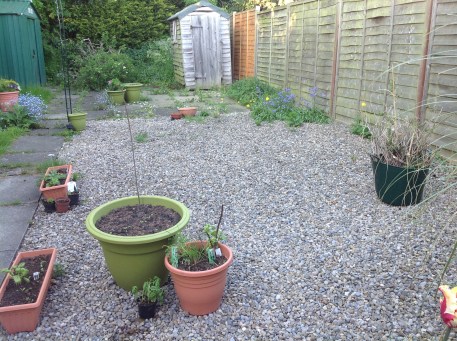
Before

doesn’t change there’s no “plot.” I love TV shows and magazine articles showing “before” and “after” scenes of people, houses and my current favourite—gardens. Transformations give us hope that things don’t have to stay a mess; why leave things that way when they can be made better?

Charlie and “the boys” on British TV’s Garden Rescue have encouraged and inspired me to do something with our back garden consisting of a long strip of grass on one side and gravel down the other.  “Patios” top either end with a footpath down the middle. It was the proverbial “empty canvas” except for the massive pampas grass that I’ve always said I’d never have, and countless little abandoned toys and bits of plastic and netting left by previous tenants. Since we’re renting and on a visa, I didn’t want to invest a lot of money but I wanted beauty.

The estate agents and the landlord gave me permission to dig up the grass for a vegetable garden but with hesitation.  “I guess the grass would grow back,” the landlord surmised. Most definitely.  Though I ordered a shiny new shovel delivered, in the end, I decided that pots would be enough since my back didn’t like the idea of digging.

Back garden 2018.

Last year

Last year I ordered and filled some plastic pots with compost, flowers and vegetables, arranging them on the gravel, as best I could–they were heavy, in a sort of river flow.  This year, I brought in more pots, compost and plants, refining the path.

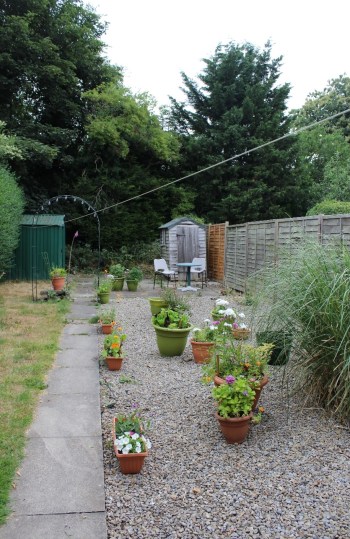
The hardscaping of the Garden Rescuers’ designs inspired me to consider some flat stones to make a proper path.  In my last garden—in the US, I had discovered enough flat stones around the property to lay a path.  My husband and I had bought and filled the car boot with extra stones from a local farmers market. Since we don’t have a car in England, we couldn’t haul any in but I wondered if there might be stones here in the garden?  Yes.  They were buried in the dirt or overgrown with ivy; it felt like a treasure hunt.  Were there more?  I needed a few more.  Yes, just enough.  I unearthed the stones and dragged them one by one to the gravel, pushing gravel aside to nestle each one in.  I couldn’t dig beds for them since the gravel has a liner but for the most part they stay in place.

IMG_20190820_113149961

This Year

I hear a lot these days about how garden paths require a person to slow down and enjoy the garden.  I walk the cement path when I’m in a hurry but take every opportunity to meander down my stone path.

Thankfully, the old three-sided shed that looked like an old time American latrine (all it needed to complete the look was a crescent cut in the door) has been torn down and removed, opening up new space.


Do not conform to the pattern of this world, but be transformed by the renewing of your mind. Then you will be able to test and approve what God’s will is—his good, pleasing and perfect will.  Romans 12:2

The First Garden—Beauty + Utility

One of the reasons I so love gardening is that life began with a garden. God—THE Gardener, planted the very first garden on the face of the earth. He had created all the plants, animals and creatures of the ground, of the sky and of the sea. Can you imagine Glorious Garden smallerall the unfurling of leaves, the colour burst of opening flowers, the swoosh of plants in upward thrust of growth? Add to those the baying, cawing and splashing of the creatures; what a glorious cacophony!  God had created all this and pronounced it “very good,” yet wilderness wasn’t enough, he wanted a garden, a place to grow particular plants in particular places.

“Now the Lord God had planted a garden in the east, in Eden; and there he put the man he had formed. The Lord God made all kinds of trees grow out of the ground—trees that were pleasing to the eye and good for food” (Genesis 2:8,9).

I’ve met gardeners who want to grow nothing but practical plants, “things they can eat,” but God not only wanted trees that were “good” for food (bore fruit), he made them “pleasing to the eye.”  We don’t have to choose between “practicality” and beauty—beauty is an essential element in nature.  Fruit comes in gorgeous reds, violets, oranges, with thin fuzzy skins, tough dimpled peels…often wIMG_0765ith fragrant flowers. A city we lived in the US has streets lined with trees billowing with faintly pink cherry blossoms each spring.

I grow a few vegetables and herbs, not so much because I save money but because home-grown food gives me such satisfaction and tastes far better than supermarket varieties. But flowers are the main reason I garden; I love to be surrounded by their extravagant colour and beauty, and as a visual artist, I love to paint them.  Jesus said that even the wildflowers are more beautiful in their colours and form than even Solomon with all his fine kingly robes.  Think about that.  We don’t have to justify gardening for beauty—God started it.

Snail Patrol

Bugs are seldom seen in my English garden but snails and slugs abound; I’ve never seen so many!  Their silvery trails crisscrossing the patio and garden walk, leaf edges img_20190731_184424713.jpgsystematically chewed in curves, and stripped stalks, all signs of the hidden army that attacks my hard to get plants.  It’s not like they have to go hungry—what about the wildflowers I allow to provide for the wildlife? What about the weeds? Ah but they are connoisseurs and prefer my tender petunias and delphiniums.
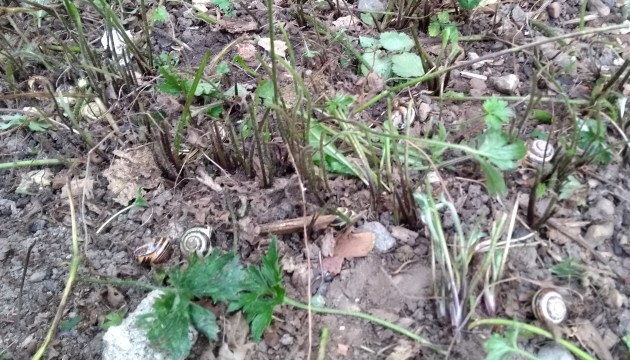
I run a “snail patrol”  as much as twice a day, running my gloved fingers under the rims of the pots (manufacturers should redesign to remove these rimmed hiding places). Then I look under the Creeping Jenny, then the dahlia leaves—even the herbs, which I thought they wouldn’t like, discovering a handful or two every time. Sometimes in every pot.

My husband began researching ways to get rid of snails in the garden and happened upon the story of the Hawaiian pineapple industry importing “giant” snail-eating snails to rescue their fields.  Unfortunately, as these things go, the predator snails were over efficient and decimated entire species of snails in the islands.  I don’t believe in using chemicals or going overboard with predator solutions—I try not to kill anything if I can help it (mosquitos and other things that attack me personally are another story) so I pull the snails away from their suction on the pot (some are bigger than I’d expect!) and relocate them to the wild part of the back garden where they can munch away on all sorts of tasty leaves and leave mine alone.

IMG_20190806_193729722

But most of my garden is in containers on gravel.  Where do they come from? I always thought that gravel would chafe the snails’ slimy underside but I guess the slime serves as a protective barrier.  Yesterday, I finally began pulling up the small bed of post-bloom wild buttercups to make way for something new.  Aha! I discovered a whole colony of yellow and black spiral-shelled snails and brown ones—fourteen in all!  Undoubtedly, more will fill the space when my new things grow but for now, maybe my plants can grow in peace.


Uproar in the Heavens

A rip-roaring thunderstorm blew through early on a recent morning—not the pitter patter of rain that we in the U.S. declare “good sleeping weather,” but thunder, lightning and high winds.  My husband said it rained “hard and steady” for three hours. Whilst this is very common in the U.S. and I’ve prayed against many such storms, thunderstorms are fairly rare in England.  Probably people would say that it simply doesn’t get hot enough—the day before, it did, especially in a house that’s built to hold heat.

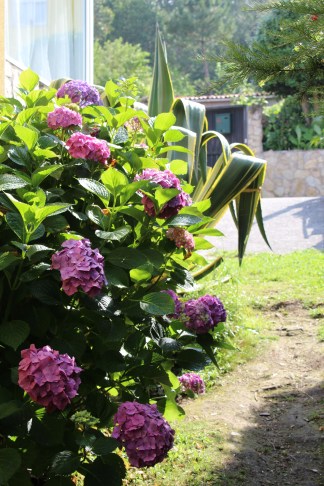
Thankfully, my garden plants weren’t beaten down by the hard rain and seemed to benefit.  Though it had rained a couple of days before, the sun had already parched my container garden.  Even sun-loving plants like sunflowers were drooping since their large leaves transpire water more quickly. In the morning though, everything looked happier.hydrangeas

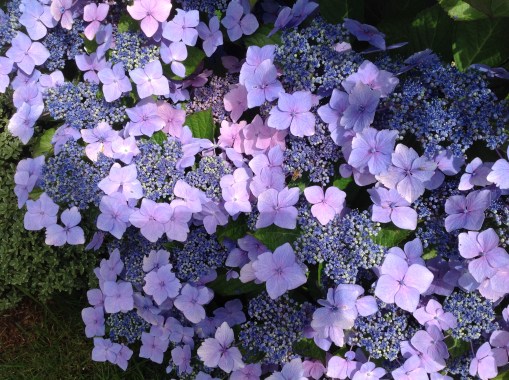
But now it rains nearly all day, nearly every day.  After a recent trip to Spain, I felt my newly opening hydrangeas were pale in comparison to the deep, rich colours I saw in that rainy region of Europe. Rain was apparently what mine needed since they’re now blooming in (at least) two wonderfully deep colours of purple.

hydrangea close-up

Imposter Peas

Some say it’s too late in the season for mangetout peas to be mangetout—well, either they’re edible or they’re not. Whilst I was away my pea plants grew taller, flowered and made peas.  I excitedly picked my first harvest in varying sizes and brought them in for my husband to cook for tea (supper). Eager anticipation in the first bite was met by a tough shell!  Maybe it was just the one. garden peasAnother and another proved too tough to eat so I freed the little green orbs from their leathery jackets making a very small serving for all the effort to grow and cook them. Friends hint that I must be mistaken and have instead grown regular peas. I checked the plants again and found that even the tiniest, newest pods already have round peas in them. In fact, the package says “mangetout, harvest: May thru Aug,” so not only are they the kind of peas to “eat it all,” but I’m well within the harvest time. I don’t think I’ll be planting those again. But then, I always say that one of the great things about gardening is that if something doesn’t work, you can throw it out and start again.

Rain, Rain Go Away

As I grew up in the US, we children would often chant, “Rain, rain go away; come IMG-5674again some other day!”  After several days of all-day rain here in Yorkshire that keeps temperatures at an almost winter, I’ve had enough rain for now.  It’s common for people to pray for rain but less so to pray for it to stop.  That’s what I’m doing, praying for it to stop but only for a couple of days. But maybe we need to store it up for when it’s dry, one might think.  Last summer certainly was dry—sunny, with almost no rain; it was lovely for outside activities but not good for the garden. My husband and I had to form our own “bucket brigade” to water the containers, even the beds, since we don’t have an outdoor hose bib. Yes rain is good, needed. And yes, it is England. However, the weather watchers warn Yorkshire of flooding—the ground and the waterways apparently can’t hold much more.  Nor can the garden.  The soil is getting waterlogged.
IMG-5672I keep reading that we should save rainwater in the garden for dry times but by the time the ground and the soil in my pots dries out enough to need more, the rainwater in my bucket (pictured above—yes, I poured rainwater from other parts of the garden into it) will have diminished through evaporation.  I suppose a rain butt (I’d never heard of one before I came to UK) would minimize evaporation but as a sojourner here, I’m reluctant to invest in the huge things.
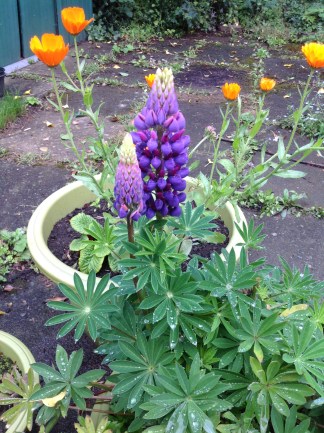
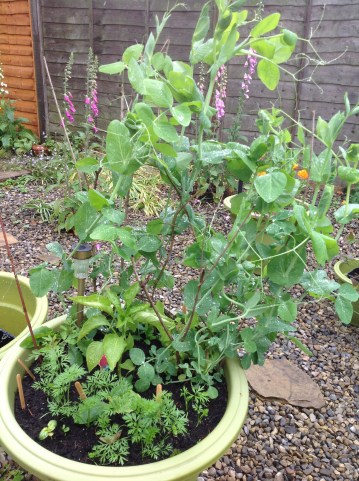
Meanwhile, my mangetout peas,”eat it all,” in English (snow peas in the US), seem to be quite happy with the cool, wet weather and have outgrown their pea brush reaching almost to my

IMG-5673

chin.  I’ve heard that lupins are “thirsty plants” so mine seem to be happy to have the rain make its way between their outspread leaves. I enjoy seeing raindrops stand on the lupin leaves, glistening in whatever light there is, like jewels. Lupins (spelled lupines in U.S.) were on my list of “musts” to grow as they’re in the same family as my home state wildflower.


Marvelous New Garden Finds

On a recent excursion to a garden centre, I was taken with the marvellous flowers and foliage I found there–a fuchsia-coloured Hebe (I wonder if it flowers like my plain ones? What a welcome parade that would be!) and a captivating deep warm pink petunia, golden-throated withIMG_4380 burgundy veins.  I’ve seen and grown a lot of petunias over the years, loving them for their bright colours, resiliency and heady fragrance but I’d never seen any like these.  I knew I “had” to have one.  It’s still going strong several weeks later with little tending. But I’ve just discovered, as I ventured out into the rainy garden to visit it, slugs and/or snails like it too though I couldn’t find any at the scene.IMG_4381
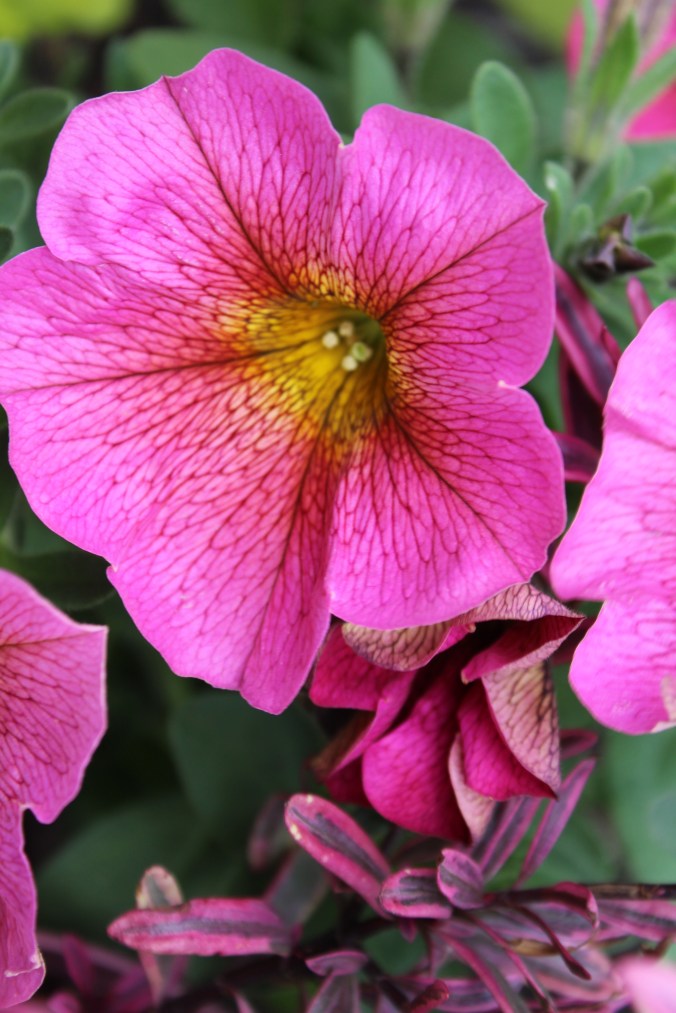
While there can be difficulties with hybrids—especially when they are proprietary like these (some are naturally hybridised while others are developed and freely shared); this Hebe and petunia each have tags with stern warnings against propagation without a license, I can’t help but enjoy them.  I’m a visual artist and I don’t like anyone copying my art without permission either.

God made the glorious plant world but gave authority to humans to make something of them. How lovely it can be when people work together with God to make things beautiful.

Also pictured are a wonderfully fragrant stock (known as Virginia Stock in the U.S.) in vibrant orchid—an old-fashioned flower that’s seeing renewed popularity, and an old faithful Creeping Jenny that readily self-propagates by roots and will come back year after year.  It’s yellow green colour is part of my garden colour palette to coordinate with deep pinks and purples.